Answers · guide reviewed 2026-09-17
Which driveway camera keeps useful detail at the car?
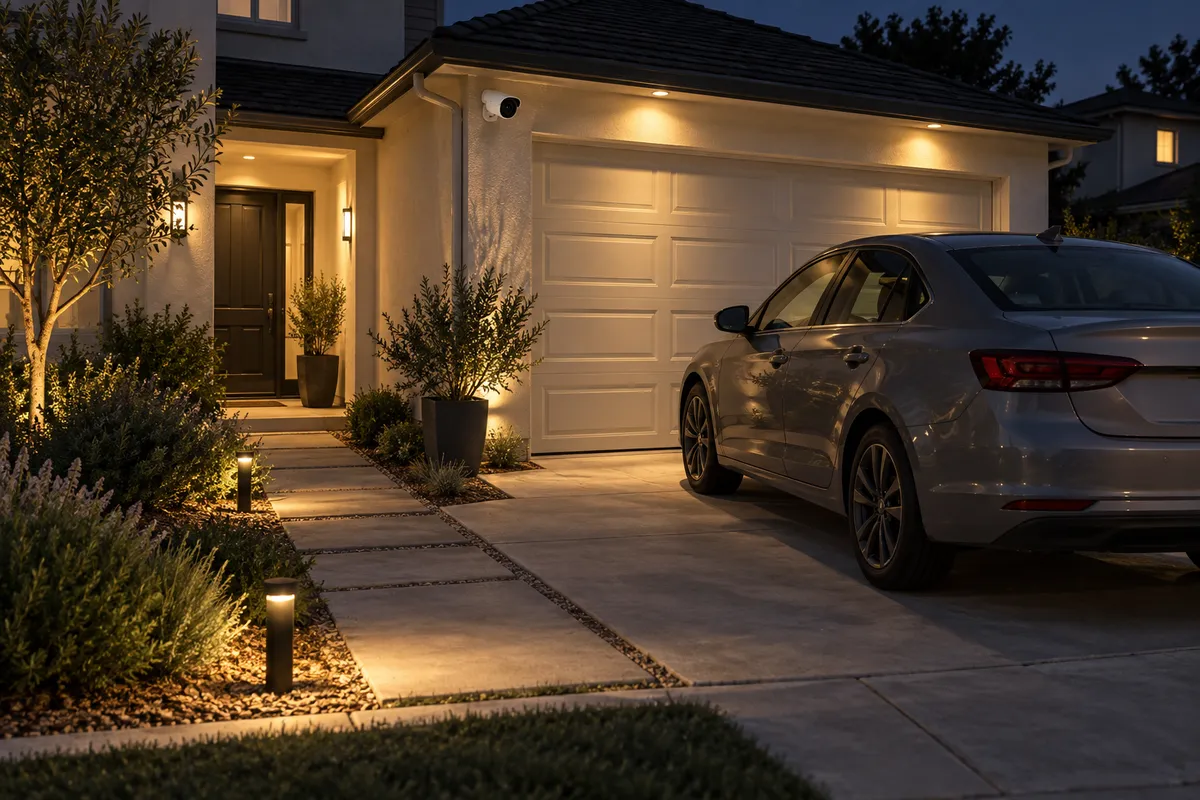
A driveway camera needs useful detail at the car, not just a wide view. From published lens and sensor figures, the Reolink E1 Outdoor Pro (94° lens, 4K) keeps a recognizable person to about 60 ft and a face you could identify to about 45 ft in daylight; among the 10 cameras below the daylight reach runs from 40 to 60 ft, and at night our planning reach drops to 25 to 60 ft. Mount so the car doors and the approach sit inside that distance, and expect no reliable license plates from a general-purpose camera.
By the How Many Cameras editorial team · Manufacturer specifications and planning estimates; not hands-on product tests.
Planning reach by model
Our planner converts each camera's published horizontal lens angle and sensor width into a planning reach: the distance at which the picture still holds 20 pixels per foot (a recognizable person) or 40 pixels per foot (a face you could identify). Night reach uses the maker's night-vision figure or the light the camera carries. Wider lenses see more driveway and keep less detail; the two columns show that trade-off directly.
| Model | Lens · resolution | Recognize (day) | Identify (day) | Night | Power | Fee to record | Price |
|---|---|---|---|---|---|---|---|
| Reolink E1 Outdoor Pro | 94° · 4K | 60 ft | 45 ft | 40 ft | Plugs into an outdoor outlet | None | $149.99 |
| TP-Link Tapo C460 | 113° · 4K | 60 ft | 32 ft | 49 ft* | Rechargeable battery | None | $84.99 |
| Reolink RLC-820A PoE Bullet | 87° · 4K | 60 ft | 51 ft | 60 ft | PoE | None | $99.99 |
| Wyze Cam v4 | 98.5° · 2.5K | 55.1 ft | 28 ft | 30 ft* | Plugs into an outdoor outlet | None | $44.98 |
| TP-Link Tapo C325WB ColorPro | 106° · 2K | 48.2 ft | 24 ft | 25 ft* | PoE | None | $119.99 |
| TP-Link Tapo C120 | 103° · 2K | 45.8 ft | 23 ft | 30 ft* | Plugs into an outdoor outlet | None | $39.99 |
| eufy SoloCam E42 | 130° · 4K | 40 ft | 22 ft | 30 ft* | Solar + battery | None | $119.99 |
| Wyze Battery Cam Pro | 108° · 2.5K | 40 ft | 23 ft | 30 ft* | Rechargeable battery / Solar + battery | None | Not published |
| Wyze Solar Cam Pan 2K | 108° · 2K | 40 ft | 21 ft | 30 ft* | Solar + battery | None | $79.98 |
| Blink Outdoor 2K+ | 115° · 2K | 40 ft | 20 ft | 30 ft* | Rechargeable battery | $3.99/mo | $99.99 |
* sensor width taken from the resolution label because the maker publishes no pixel figure. Models whose maker publishes only a diagonal lens angle are not listed; they have model pages but no planning reach. Manufacturer specifications, not our tests.
Plan one driveway viewPlan an overview plus a closer view
Put the doors inside the identify distance
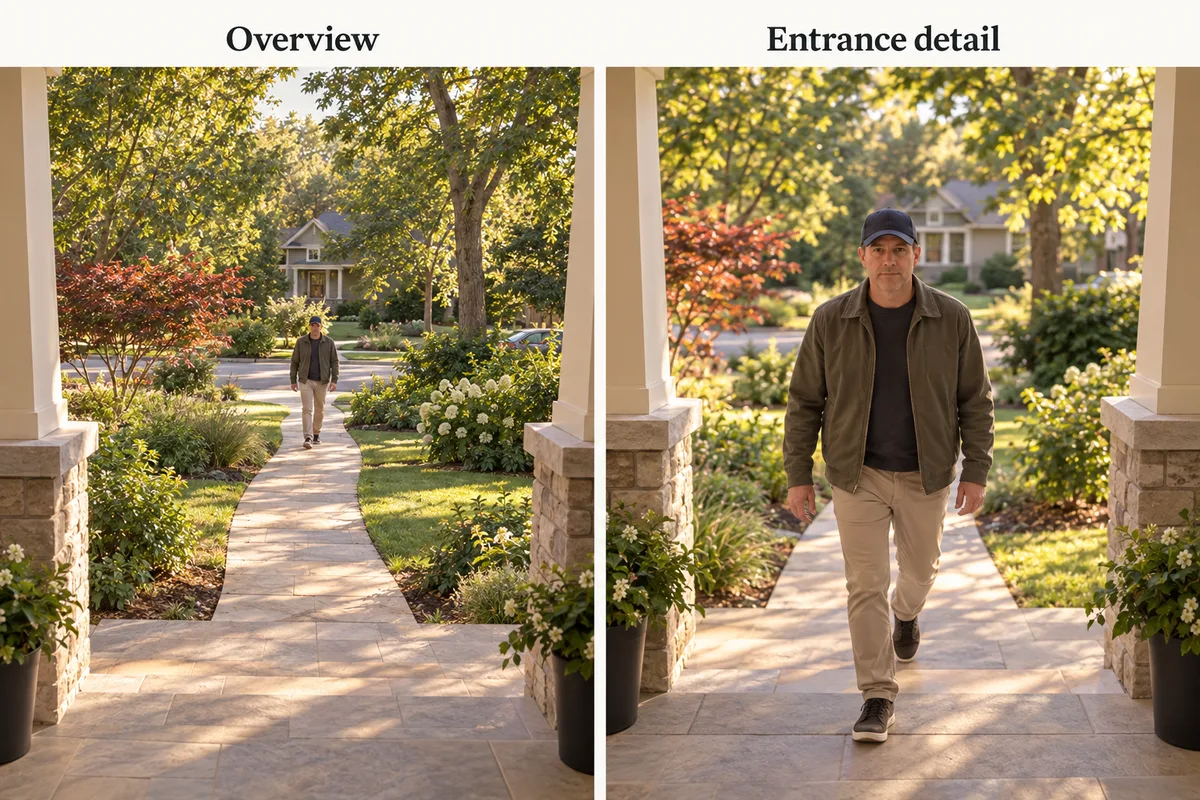
The number that matters is the distance from the mount to the car doors and to the point where someone leaves the street. If that distance is beyond the identify column, the camera will show that something happened without showing who. Moving the mount closer beats buying more resolution: halving the distance doubles the detail, while stepping from 2K to 4K adds far less at the same spot.
Night is the driveway's normal condition
Most car break-ins happen after dark, so plan for the night column, not the day one. A hardwired floodlight camera lights the scene and keeps color to about 40 ft in our model; the floodlight shortlist lists the ones that need a fixture circuit. Infrared cameras keep a black-and-white picture at shorter range and can wash out a face that walks up close. Whatever you choose, headlights sweeping across the lens are the scene the camera has to survive; test with the car pulling in.
License plates are a different job
A wide driveway camera at eave height does not read plates dependably. Axis's guidance on plate capture describes specific alignment, angle and exposure settings for that task, and none of the general-purpose cameras above are set up that way by default. If a plate is what you need, treat it as a separate, dedicated camera position aimed along the drive at bumper height, and accept that the same camera will be poor at faces.
One view or two
A single camera can cover a short single-car driveway when the doors and the street approach both sit inside its identify distance. A two-car driveway, a car parked nose-in against the garage, or a drive that turns behind a hedge usually needs an overview plus a closer view of the doors. The planner's driveway entries above open the house layout with the driveway already required, so you can see what one position does and does not reach before adding a second.
Power at the driveway position
Driveway mounts are often the farthest from an outlet and the closest to an existing outdoor light. That makes a fixture-wired floodlight camera or a plug-in camera on the garage circuit the usual choice, with battery or solar for a position with no wiring at all; the power guide separates the three. A battery camera at the driveway records on motion only, so a car sitting still is not being filmed between events.
Related questions
Will a 4K driveway camera read license plates?
Not reliably from resolution alone. Plate size in the image, angle, motion, exposure and headlight glare decide it; Axis's plate-capture guidance calls for specific alignment and settings. Treat dependable plate capture as a separate installation requirement.
Is one camera enough for a two-car driveway?
It can give an overview, but a parked car hides the far doors and approach. If the doors and the route to them are not both inside the reach distance from one position, plan two views.
Should a driveway camera have a floodlight?
A floodlight camera lights the scene, which keeps color detail at night to about 40 ft in our planning model, but it needs a fixture circuit. A battery or solar camera relies on infrared or a small spotlight and a shorter night reach.
How high should a driveway camera be mounted?
High enough to be out of easy reach and low enough that the lens still sees faces rather than the tops of heads. Test with the car parked normally and someone walking to each door before drilling.
MAKE IT FIT YOUR HOME
Choose your next step
Use the conditions from this guide as a starting point. Your current list stays in place while you compare.
CHOOSE DEVICES
One driveway view
Compare a single camera for a view you have already checked. Power is your choice.
Compare in My list → Plan positions firstCHOOSE DEVICES
Overview + a closer approach
Compare two-camera setups when you have decided that two separate views are needed.
Compare in My list → Plan positions firstCHOOSE DEVICES
Hardwired floodlight cameras
Compare the documented floodlight cameras. Each needs a suitable fixture circuit; recording plans differ by model.
Compare in My list → Plan positions firstChoose a bundle or individual devices, then add them to My list for compatibility checks and store links. A selected quantity is not a guarantee of coverage.
Sources & checks
- How planning reach is computed (20 and 40 pixels per foot)
- Axis: license plate capture requires specific alignment and settings
- Reolink E1 Outdoor Pro: manufacturer specifications
- TP-Link Tapo C460: manufacturer specifications
- Reolink RLC-820A PoE Bullet: manufacturer specifications
- Wyze Cam v4: manufacturer specifications
Guide checked 2026-09-17. Product prices and specifications have their own checked dates on each model page.